



In a 2013 article, philosopher L.M. Sacasas describes how he coined the Borg Complex. The concept draws its inspiration from the cybernetic collective the Borg in Star Trek — a collective of beings embodied by a mixture of machine and biological life. No Borg has its own will, its own thoughts, nor its own identity. All think and act as a single mind, a mind whose only goal is to grow and assimilate more.
The Borg travel through space converting other beings into part of their own collective. They take over individuals against their will, connect them to the collective, and completely erase their own personalities. Knowledge is absorbed, but culture, memories and individuality disappear.
When assimilation occurs, these words are usually spoken: "We are the Borg. Resistance is futile."
"We are the Borg. Resistance is futile."
The Borg Complex gives us terminology to describe people who argue that resistance to technology is pointless. They argue that becoming part of the collective that integrates technology into human life is self-evident and unavoidable.
In his review of the Borg Complex, Sacasas compiles a list of characteristics, reproduced here with my own clarifications. You've likely encountered someone who possesses a Borg Complex, or at least read about someone who fits the profile. Many figures in the tech world, and the occasional politician, tend to display several of these traits:
Eight signs of the Borg Complex
- Makes grand but unfounded claims about technology. Often someone will claim that a certain technology will solve all the world's problems. This is guaranteed to feel familiar in today's endless discussions about "AI." At the same time, an exact definition of what "AI" technology actually entails is absent, which makes the prediction simplistic and toothless — and also unusable. The prediction is primarily in service of manipulation… or wishful thinking.
- Uses the word "luddite," in a historically revisionist way, as a slur. By referring to them as luddites, critics are dismissively branded as reactionaries. In reality, the Luddites' protests were about how machines affected working and living conditions, and contributed to deteriorating product quality. As a slur, more often than not, it entirely misses its mark.
- Pretends to listen to objections but ultimately dismisses them. Certain challenges may be acknowledged to some extent, only to be ignored anyway. The Borg Complex means that issues such as climate impact, labor exploitation and disinformation become unimportant, as they can always be tolerated with the conviction that technology will only get better and will solve all these problems. Quotes frequently leaned on: "That issue will be gone in the next version." or "Today's AI is the worst you will ever use." The latter is particularly striking because it insinuates the technology is worsening day-by-day.
- Equates resistance or caution with reactionary nostalgia. Criticism or resistance is always interpreted as merely clinging to "the old ways." And the term "old ways" is used without being more specific or offering any analysis of advantages and disadvantages, beyond promising that "the new" always delivers "efficiency" and "speed." Alternative approaches and visions of the future that do not include certain technologies will always be seen as inferior, outdated and unrealistic by those with the Borg Complex.
- Presents assimilation as objective fact. "This is the new reality, everyone must adapt." They genuinely see no other path than for everyone to get with the program and follow their example. There is a fondness for the expression "you can't put the toothpaste back in the tube," which serves as a metaphor for the impossibility of going back. "Resistance is futile," it again implies, in keeping with the Borg's binary convictions. Every engineer and independent thinker worth their salt knows, of course, that you absolutely can put the toothpaste back in the tube. It didn't materialize in the tube and is – as is AI – entirely a human invention.
- Spreads narratives about a bleak future for those who refuse to adapt. Beyond "luddite" as a slur, some form of misery is often predicted for those who fail to march in step. They will lose their jobs, become redundant, and fall behind in everything they attempt. For anyone witnessing this kind of rhetoric, it is easy to perceive it as extraordinarily self-righteous. The advocate has "seen the light" and implies that others are late to do the same. A frequently repeated and celebrated quote: "AI will not replace humans. Other humans using AI will replace those who don't." Note that they simultaneously call themselves optimists.
- Expresses contempt for previous cultural achievements. The old has no value in comparison to the new. Creative, manual professions are often dismissed by ardent tech advocates with the Borg Complex as outdated, and they assume that others share their own view of what is good and desirable. Much of what is called generative AI today is built on content created by artists, writers and creators who were never given the opportunity to consent to this use of their work. A person with the Borg Complex may sometimes acknowledge this as a harm, but considers it a necessary one. Regulation to protect people from exploitation would destroy the future, many argue. The so-called optimism is indeed tendentious.
- Invokes historical anxieties solely to dismiss present ones. "People were worried before too, and things turned out fine." It is popular among those with the Borg Complex to reference and ridicule past anxieties and fears about things that have since been assimilated. They are reluctant to acknowledge that there has always been legitimate criticism of new technology, and that not everything has improved despite the promises that so often accompany technology's advance.
But worst of all is the attitude toward thinking.
You'd best not think too much
The problem with the Borg Complex is not a question of ultimately being right or wrong. Sometimes things do unfold in the way that tech enthusiasts preach. And sometimes not at all. That is precisely what is so harmful about acting on fatalistic convictions. The future is not predetermined. Yet technofatalists are quick to strip agency from those who choose to point out problems in efforts to encourage more considered choices.
The grave danger of the Borg Complex is its ability to sabotage critical, independent thinking. When people in positions of power claim superior technical knowledge and tell others that they must hurry to adopt technology because it is inevitable, I call that think-hostility.
Personal agency and the capacity to question and form one's own opinions are disabled by voices that convince people it is too late to do anything differently. Think-hostility drives a pattern of behavior where people
- adopt without weighing the pros and cons,
- take in without scrutinizing credibility,
- consume without regard for those who suffer harm, and
- use without evaluating the broader impact of that use.
The delusion escalates when the person who sees technology as inevitable also takes on the role of optimist and labels skeptics as pessimists. Think-hostility does not stop at claiming that the path is predetermined — it also ridicules those who want to pause and debate that very claim.
When those in power embrace fatalism and the deterministic message that alternative paths are no longer available, a power game grows in which ordinary people find it increasingly difficult to have their objections heard or their concerns acknowledged. Those who resist risk being branded as "naive" or "ignorant."
The insistence on digital assimilation as the only way forward becomes a chimera. It is of course not the case that people can truly see into the future — the purpose above all is to seize power over others, so that one's own vision and will is given more space. A space further extended by journalists acting as megaphones for those in power rather than as watchdogs for citizens.
"Don't think. Adapt. It is inevitable."
Think-friendliness
I want every person's concerns to be seen as legitimate — regardless of background, education and experience. My focus is on understanding and assessing what can go wrong. Evaluating who benefits, who is sidelined, and who is exploited. By encouraging critical thinking, it is possible to be a loving counterforce to the arrogance and power claims of technofatalism.
Resistance can be boundlessly beautiful. And it has nothing to do with ignorance. It has everything to do with a desire to think for yourself. To be given time for reflection. It is rooted in care for yourself and others.
The charlatans reading fortunes in AI slop are not revealing the future — they want to secure their own dominance and have you pay for it. ▪️

Trivia
*The word of course simply borrows the ending of the word cyborg.
Scenes from Star Trek: First Contact
Watch this lecture
Beware the power of predictions. A brand new lecture from philosopher and author Carissa Véliz. It is only 12 minutes long and well worth your time.
Philosopher, author and TED alumna Carissa Véliz reveals the hidden power of prophecies and predictions, from Roman emperors who banned prophets to AI algorithms that are quietly making decisions about your life right now. We often associate predictions with wisdom, she says, but they are really about attempts to seize more power. So the next time you hear someone say that a certain outcome is inevitable, remember that they are not describing the future — they are selling it.
A clip about forced inevitability
In season 5, episode 6, of the TV series Hacks, a billionaire wants to sell the main characters an app for automated writing. He wants access to their collected content so that the app can write in "Deborah's voice." Ava, who writes for Deborah, then explains why she hates AI.
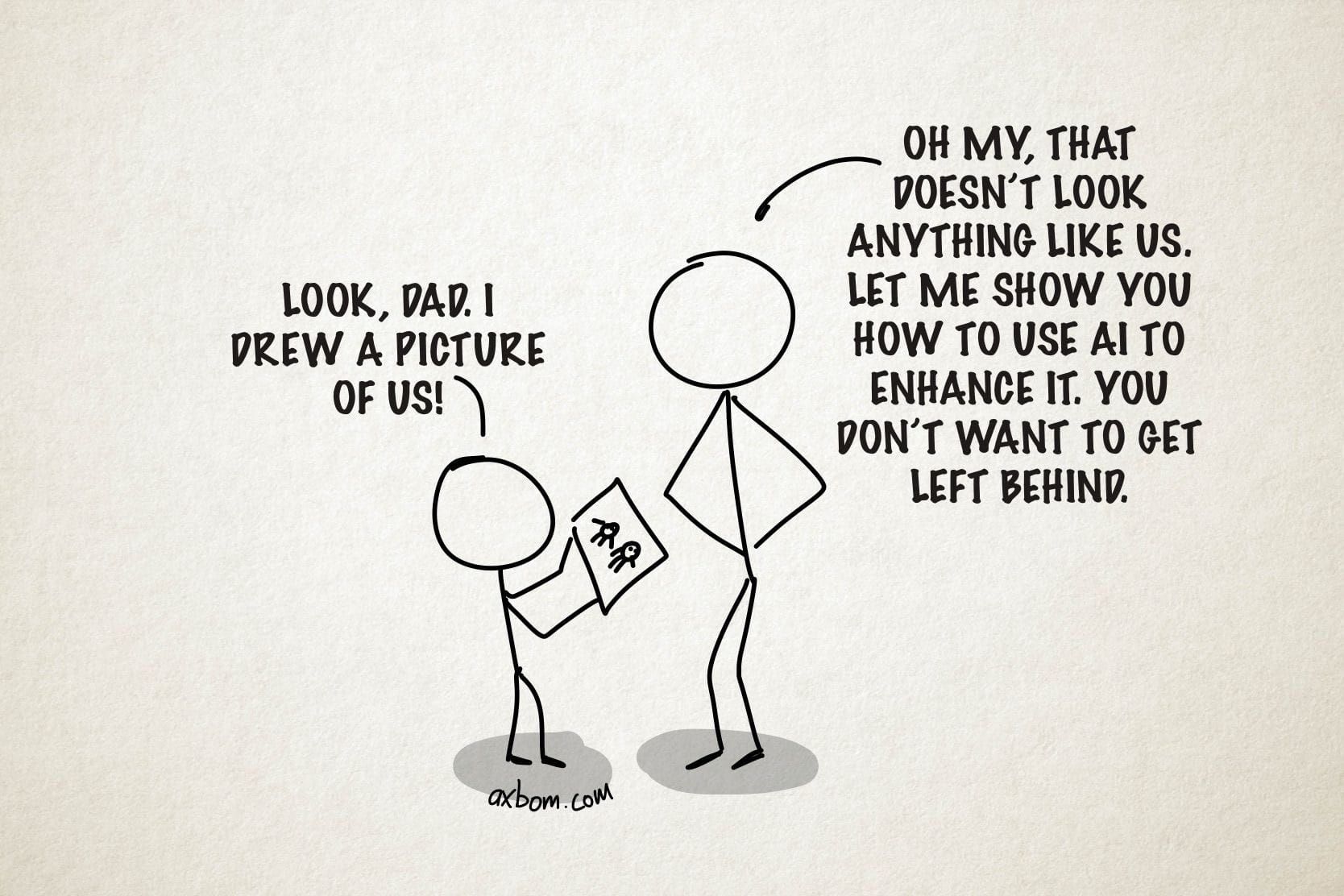
My latest cartoon
References
- del Canuto, Eleonora (2025). Technofatalism and Modern Geopolitics: From Imaginaries to Instruments of Power. SSRN
- Marx, Leo & Roe Smith, Merritt (Eds.) (1994). Does Technology Drive History? The Dilemma of Technological Determinism (pp. 101–113). MIT Press
- Merchant, Brian (2023). Blood in the Machine. Hachette Book Group
- Sacasas, L.M. (2013). Borg Complex: A Primer. The Frailest Thing
- Sacasas, L.M. (2021). Resistance is Futile, The Myth of Tech Inevitability, The Convivial Society
- Wikipedia, Technological determinism, Wikimedia Foundation